
Training Your Dog With Positive Reinforcement
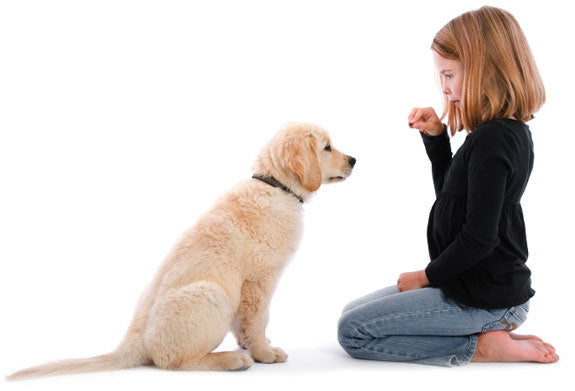
Why Positive Reinforcement Dog Training Works
Positive reinforcement dog training is a friendly, non-punitive method of teaching your dog to perform behaviors using Dog Food, Dog Treats or other positive actions as a reward.
Rewarding appropriate dog behavior makes that behavior more likely to occur in the future and is one of the most powerful tools you can use to shape or change your dog’s actions. PupLife.com strongly advocates using positive reinforcement dog training as it not only teaches your dog what behaviors you desire (as well as those you don’t) in a humane manner, but also because it creates stronger bonds between you and your dog.
Compulsion dog training or training based on physical punishment usually involves some level of discomfort or even pain and is not recommended as it may cause your dog to bite in order to defend himself. Punishment may also be associated with other stimuli, including people, present at the time the punishment occurs. For example, a dog that is punished for getting too close to a small child may become fearful of or defensive around that child.
Getting Started With Positive Dog Training
It always helps to have the best positive reinforcement Dog Training Supplies to get started on the right path. PupLife has a great selection of training gear, including No-Pull Harnesses, Martingale Collars and even Dog Training Books. With the right supplies, you'll be ready to start training your best friend.
Timing is also key with positive reinforcement dog training. Your dog must be rewarded immediately for responding appropriately to a cue. That is, through a reinforcement (food), your dog will associate particular behaviors with actual rewards. Consistency is also essential. Everyone in the family should use the same cue system and should never reinforce the wrong behavior. For example, if you cue your dog to sit, he should be given a dog treat the moment his behind hits the ground. If you wait until he stand up again, the moment will be lost and he will think he is getting rewarded for standing.
Using Positive Rewards: Play, Treats, Or Toys
Most dogs will happily work for tasty dog treats. You should choose treats that are small, soft, and easily broken apart. Treats should be highly valued by your dog and easily consumed. It is difficult to train a dog when he spends valuable time chewing and swallowing the reward treat. You want your dog to quickly eat her treat and look to you for more. Experiment with several different treats and find out which ones work best. PupLife carries a nice variety of healthy Dog Training Treats that work great for positive reinforcement.
For dogs that are not motivated by food, try training using praise (happy talk). If your dog is motivated by Dog Toys, try rewarding him with a game of fetch. Some dogs are motivated by the company of other dogs. In this situation, the reward is play time with doggy pals.
Continuous Positive Reinforcement
In addition to the food reward, each time your dog responds appropriately to a cue, you should also offer verbal praise. The sequence should look something like this: you cue your dog to sit, she sits, you say “Yes!” and reward her immediately with a treat. When your dog is learning a new behavior, he should be rewarded every time he does the behavior (continuous reinforcement). It may be necessary to use “shaping,” with your dog (reinforcing something close to the desired response and gradually requiring more from your dog before he gets the treat). For example, if you’re teaching your dog to roll over, you might reward him first for laying down, then for laying down and rolling on his back, and finally for laying down and rolling all the way over.
Rewarding Good Behavior
Once your dog responds reliably to a cue you should only reward her for staying committed to the behavior. For example, if you cue your dog to sit and stay, you should reward her only when she is tempted to break the sit and doesn’t (like if she sees another dog walk by and doesn’t get up).
Dog Training: Think Positive!
Dog training should be a fun and happy experience for your dog and for you. After all, we want our canine companions to enjoy being with us as much as we enjoy being with them!
Related Dog Care Tips
Teach Your Dog To Come When Called
Top 3 Mistakes New Dog Owners Make
How To Choose The Right Dog Trainer