
Improving Your Dog's Quality of Life Through Stretching By Jorn Oleby

Canine Massage & Stretching Tips
Many dog owners invest considerable time being active with their dogs through obedience training, hunting activities, tracking and protection exercises at training grounds, out in the countryside or in the forest. These activities allow us to spend time with our dogs while also keeping them physically and mentally alert.
Professionals, including police and security guards, use dogs at work. We expect these dogs to have a well-developed physique in order to perform the work they are trained to do. A lot of time and money is spent on training a smart and efficient dog. There is considerable research and many opinions on the topics of what food and exercise is best for our dogs. We all have our animals’ best interests at heart. Good care and high quality dog supplies are essential. A high quality, comfy Dog Bed is also a must have - your pet requires ample rest to feel at their best.

Above: An orthopedic dog bed can come in many sizes and styles. This Orthopedic Cuddler Dog Bed by Mixjoy is a favorite for dogs that like to snuggle.
No matter how well we take care of our dogs, disease and injuries do still occur. If the injury is related to the muscles, tendons, joints or ligaments a vet or physiotherapist can help. If there is a defect in the hip or elbow joints and in cases caused by poor breeding, the only treatment available is pain relief.
As dog owners there is nothing we can do to repair problems related to poor breeding nor can we prevent all accidents. However we can prevent muscle related problems and strain injuries by massaging and stretching our dogs regularly. This keeps the dog well-balanced physically and psychologically, allowing him to retain the agility of a young dog to an advanced age.
A well-functioning dog retains his natural elasticity and suppleness. A dog with restricted mobility has short and stiff muscles. When a dog has shortened musculature or tonicity, pressure is exerted on the joints leading, in turn, to decreased mobility. This ‘strangles’ the blood vessels and impairs blood circulation. Muscles, joints, tendons and ligaments then receive insufficient nutrition and less oxygen. Reduced blood flow also means that lactic acid accumulated in the muscles is not naturally transported away. The lactic acid builds up along with other waste products leading to irritation of the pain receptors in the muscles. The dog experiences pain. Pain, in turn, causes further tension and reduces blood flow even more. A vicious circle arises and can persist for some time if it is not discovered and treated.
Discomfort arising from short and stiff muscles is something that we ourselves and our dogs can suffer from if we don’t take care of our physical condition. Another condition that may reduce our dogs’ mobility is Arthrosis which is usually formed of fibrous connective tissue and cartilage. Arthrosis is very common in older persons and dogs, and predominantly affects weight-bearing joints. Articular cartilage becomes soft, frayed and thinned.
However young people and dogs may develop Arthrosis due to genetic predisposition, injuries or a combination of excess body weight and too little exercise. A common symptom of Arthrosis is stiffness and lameness. Studies have shown that regular massage and stretching help prevent and reduce the effects of Arthrosis and age related stiffness.
Massage and stretching are an effective way to prevent muscle related problems and strain injuries and improve the quality of your dog’s life. Massage and stretching should complement daily exercise, obedience training and proper diet and help build a strong bond between you and your dog.
Warming up before activity has a preventative effect and stretching is just as effective after the dog has used its muscles. The dog should have warmed up and exercised before you start to stretch the muscles, and I recommend that you allow your dog to wind down after physical exertion. Let the dog walk for a while on lead in the same way a race horse runs an extra lap at half the pace to round off the race. This helps to remove lactic acid and waste products. As with massage it is important that the dog is relaxed before you start this treatment.
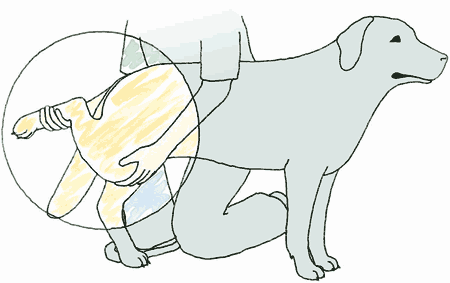
Stretching the back upper foreleg and the flexor muscles of the foreleg
Begin by stretching the back of the dog’s upper foreleg and the flexor muscles of the foreleg. Hold the dog’s elbow with one hand, grasping the wrist with the other. Move the leg forward and upwards, stretching the elbow joint. Stretch the muscle slowly and carefully to its full extent. You will feel when the muscle becomes taut, causing resistance at the back of the upper foreleg. The ultimate position can vary considerably depending on age, breed and mobility capacity.
Hold this position for 15 to 30 seconds. Repeat the movement between 1 and 3 times. At each repetition you can gently try to extend a bit more. The aim is to work up good mobility in the muscle by stretching. The result can be seen in extended gait. If the muscle is shortened the dog might appear to be lame.
The forelegs act as supports for the torso and bear a considerable proportion of the dog’s weight. Overweight dogs place greater pressure on these joints and ligaments. The same is true of large, heavy breeds. If they also suffer from shortened muscles the pressure on the joints can be considerable. By stretching you keep the muscles extended and pliable and also increase the mobility capacity around the joints.
Warming up can involve walking with your dog on lead for 15 to 20 minutes before allowing him to run freely. In this way the muscles soften up and are ready for physical activity. Competitive or working dogs should warm up in a more goal-oriented way.
Below you will find a check list that might come in handy when warming up.
First remember that the dog should have warmed up and exercised before starting a competition or an activity session. I also strongly recommend that you allow your dog to wind down after a competition or an activity session before any stretching activities.
Here is a check list that may be used before a competition or active session.
- Let the dog walk slowly for a while and then increase the tempo for 2-3 minutes.
- Let the dog trot for 2-3 minutes.
- Let the dog gallop for one minute.
- Then let the dog make some short explosive moves.
- Let the dog wind down a little by going back to trotting and then walking.
- Warming up does not tire the dog but rather increases blood circulation and warms up the muscles ensuring that the joints are lubricated and more supple.
- The dog is now ready to perform.
After the warm up you can also easily test your dog’s mobility using the eight most common stretching techniques. You should be sensitive to your dog’s signals. The dog should not experience any discomfort. If he does, don’t hesitate to contact your vet.
Place one hand directly above the knee joint and the other hand on the lower part of the leg around the hock joint. Lift the leg upwards so that the knee is bent. Push gently upwards and backwards with the hand positioned above the knee joint.
After completing a competition or an activity session let your dog wind down and then carefully do some stretching exercises. And when you come home reward your dog with massage and you will get a dog that is happy to perform and ready for new challenges. Massage and stretching are an essential and a low cost investment in your dog’s health and can greatly improve the quality of your dog’s life.
For further information on caring for your pet's comfort (especially for elderly pets), read the ind-depth article Reiki Healing Your Dog: An Interview With Annette M. Amelkovich. Another great read is Dog Arthritis: A Pain In The Joint. For pets that might need to lose a little weight, check out our article Is My Dog Overweight?. With some serious attention to detail and a lot of love, we can care for our dogs and provide them with the comfort that they deserve.
About Jorn Oleby
Jörn Oleby is the author of the book Canine Massage and Stretching – A Dog Owner’s Manual. Pictures used from the book. Article used by permission.